THE RISING POWER OF WOMEN INVESTORS
%20--%3e%3csvg%20version='1.1'%20id='Layer_1'%20xmlns='http://www.w3.org/2000/svg'%20xmlns:xlink='http://www.w3.org/1999/xlink'%20x='0px'%20y='0px'%20viewBox='0%200%20295.5%20295.5'%20style='enable-background:new%200%200%20295.5%20295.5;'%20xml:space='preserve'%3e%3cstyle%20type='text/css'%3e%20.st0{fill:%23231F20;}%20%3c/style%3e%3ctitle%3eclock%20icon%3c/title%3e%3cpath%20class='st0'%20d='M268.8,147.7c0,66.9-54.2,121.1-121.1,121.1c-66.9,0-121.1-54.2-121.1-121.1S80.9,26.6,147.8,26.6V0%20C66.1,0,0,66.1,0,147.8s66.1,147.8,147.8,147.8s147.8-66.1,147.8-147.8c0,0,0,0,0,0H268.8z'/%3e%3cpolygon%20class='st0'%20points='134.4,80.6%20134.4,134.4%20134.4,147.8%20134.4,161.1%20187.8,161.1%20187.8,134.4%20161.1,134.4%20161.1,80.6%20'/%3e%3c/svg%3e) 4 min read
4 min readHave you noticed the swelling presence of women within today’s investment circle? Lately, more women investors and female founders are making their presence felt in the venture bankroll. In this age of technology and innovation, inclusion and diversification are absolutely vital.
Increased financial backing
First, we must highlight the growth in funding behind businesses and startups, which are founded and co-founded by women. In 2018, a total of $44.8 billion was invested in such companies, and $26.7 billion in 2019, respectively the highest and second highest amounts of annual investments in the past decade for that category.
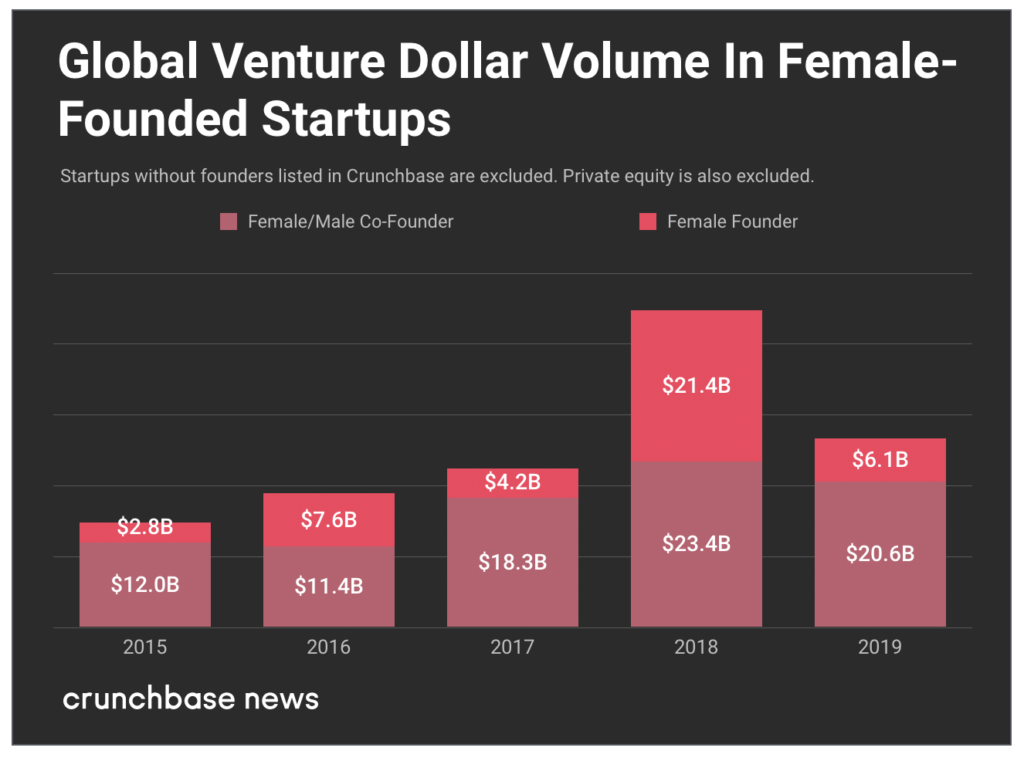
In fact, there were 21 unicorns (companies valued over $1 billion) founded by women in 2019 alone, six more than 2018 and 13 more than 2017 (source). Although it makes up 4% of the current startup unicorns, that’s the highest it’s ever been, and we believe this slow but steady rise will keep trending in that direction.
Notable investors right now
Investors like Jennifer Neundorfer (co-founder of Jane VC), are aiming to put more power in companies, which are led by women and give them more seats at the table. She spoke with Crunchbase about wanting those in the investment world to not look at this subject as charity; that completely misses the point. All investments carry a level of risk, but gender shouldn’t be a determining factor. Monique Idett-Mosley mimics this sentiment. With an almost “angel investor” mindset, her firm, Reign Venture, is specifically focused on women and minority led tech startups (take a look at our post on Angel Investing for a refresher on the term). With Reign, she seeks to disrupt the disproportionate statistic of only 0.0006% of venture funding going to black women since 2009.
Now, when it comes to the cream-of-the-crop in investing, one list comes to mind: The Midas List. This annual list by Forbes, ranks the leading investors and their firms based on dollar size exit amounts and the number of highly valued private companies, which carries serious weight for those on it. In the 2019 list, 12 women made the 100-person list, the highest number since the list was created with three cracking top 20. One of the highlighted women is Kathy Xu. She is the highest ranked woman on the list, placing sixth. Her fund, Capital Today, has made her one of China’s top investors due to a very early stage $18 million bet on JD.com, now one of China’s top online retailers and yielding a $2.9 billion return to the firm when it went public in 2015.

PHOTO BY BEWAKOOF.COM OFFICIAL ON UNSPLASH
Sonya De Rycker, who ranked second in the The Midas List Europe, is also a big figure in the EU for investment. She played a major role within Accel (one of the EU’s most prominent VCs) and their investment in Spotify, which of course went public and carries a current market cap around $28 billion. There were a total of three women within the EU top 20 including De Rycker, Reshman Sohoni (co-founder of Seedcamp; backers of Revolut, TransferWise and UiPath) and Luciana Lixandru (partner at Accel).
UK-based Blossom Capital, an EU fund co-founded by Ophelia Brown, is another fund going past expectations. They have landed a $185 million fund within less than two years of their first $85 million fund closing. According to Cambridge Associates, Blossom claims to sit within the top 5% of US and EU-based funds in 2018 and 2019 - quite an impressive feat considering its young age (see full interview here).
To Wrap Up
Diversification is important in investing beyond just filling a quota. Different genders and races experience life in very different ways, creating unique world views and ways of seeing things – an outlook vital to technological advancement and investors making more inclusive choices.
An inclusion of all genders is required for developing a sustainable financial market. One controlling gender must not continue to be the investment industry standard.
Takeaways
- In just the past two years, a total of $71.5 billion has been invested in startups founded by women, larger than the investments made during 2015-2017, totaling $56.5 billion.
- In the 2019 Midas List, there have been a record number of women ranked, totaling a record 12 out of 100 investors listed; but it’s not enough, we want and need that number to continually increase.
- More women in investment and funding circles are beneficial for different views and more perspectives when considering companies in their pitch meetings.
- Women are getting more notoriety as successful business and startup founders, and the industry is beginning to take note with more investment funding heading towards companies founded by and with women.
Did learning about the rise of female investors inspire you? To invest in innovative companies or to raise investments through the STOKR marketplace, follow this link.
BY DIAMAAN GUEYE
Discover related insights

SPREAD YOUR WINGS AND LEARN ALL ABOUT ANGEL INVESTORS
Maybe you know the term already, or maybe you don’t. Traditionally, the definition of an angel investor is known to be an individual of high net worth, who provides financial assistance to startups and/or entrepreneurs. Angel investors usually help startups/entrepreneurs get the ball running, by assisting with an initial one-time or ongoing injection of financial backing to help the business get off the ground.

LIBRA: A DIGITAL CURRENCY FOR OUR DIGITAL WORLD

A STAR IS BORN - EU PROSPECTUS REGULATION IN FULL FORCE




Disclaimer: This website is operated by STOKR S.A., a Luxembourg public limited liability company (société anonyme), having its registered office at 9, Rue du Laboratoire, L-1911 Luxembourg and registered with the Luxembourg trade and companies register (Registre de commerce et des sociétés, Luxembourg) under number B226662, authorised as a crypto asset service provider (CASP) and as a payment institution (PI) and registered with the CSSF. STOKR S.A. is a technology and platform service provider. It does not issue, offer, place, market or promote financial instruments, does not provide investment advice, and does not act as an intermediary between investors and issuers. Instruments presented on this website are offered by third-party issuers on their own behalf and on their own responsibility. Other entities named on this website, including issuers and their management companies, are separate legal entities; they are not part of STOKR S.A.'s authorisations and may be subject to a different regulatory framework, or to none.