BITCOIN MINING; A SERIES - PART 3: GPU MINING & THE HARDWARE TREND
%20--%3e%3csvg%20version='1.1'%20id='Layer_1'%20xmlns='http://www.w3.org/2000/svg'%20xmlns:xlink='http://www.w3.org/1999/xlink'%20x='0px'%20y='0px'%20viewBox='0%200%20295.5%20295.5'%20style='enable-background:new%200%200%20295.5%20295.5;'%20xml:space='preserve'%3e%3cstyle%20type='text/css'%3e%20.st0{fill:%23231F20;}%20%3c/style%3e%3ctitle%3eclock%20icon%3c/title%3e%3cpath%20class='st0'%20d='M268.8,147.7c0,66.9-54.2,121.1-121.1,121.1c-66.9,0-121.1-54.2-121.1-121.1S80.9,26.6,147.8,26.6V0%20C66.1,0,0,66.1,0,147.8s66.1,147.8,147.8,147.8s147.8-66.1,147.8-147.8c0,0,0,0,0,0H268.8z'/%3e%3cpolygon%20class='st0'%20points='134.4,80.6%20134.4,134.4%20134.4,147.8%20134.4,161.1%20187.8,161.1%20187.8,134.4%20161.1,134.4%20161.1,80.6%20'/%3e%3c/svg%3e) 8 min read
8 min readBitcoin doesn’t come out of thin air, it’s mined - as we all know. In the earlier days, the Bitcoin network was designed to run on computer CPUs found in ordinary laptops and desktops. With a dedicated setup, a few computers, and some luck, you could get a few Bitcoin per day.
In 2010, this didn’t amass much profit and it was really a small hobby for most. Very few companies had mining specific hardware on the market back then due to the complexity of the processing chips. Fast forward 12 years and you will realize how far mining technology has come. It can be one of the more lucrative ways to earn money in the tech world if done right.
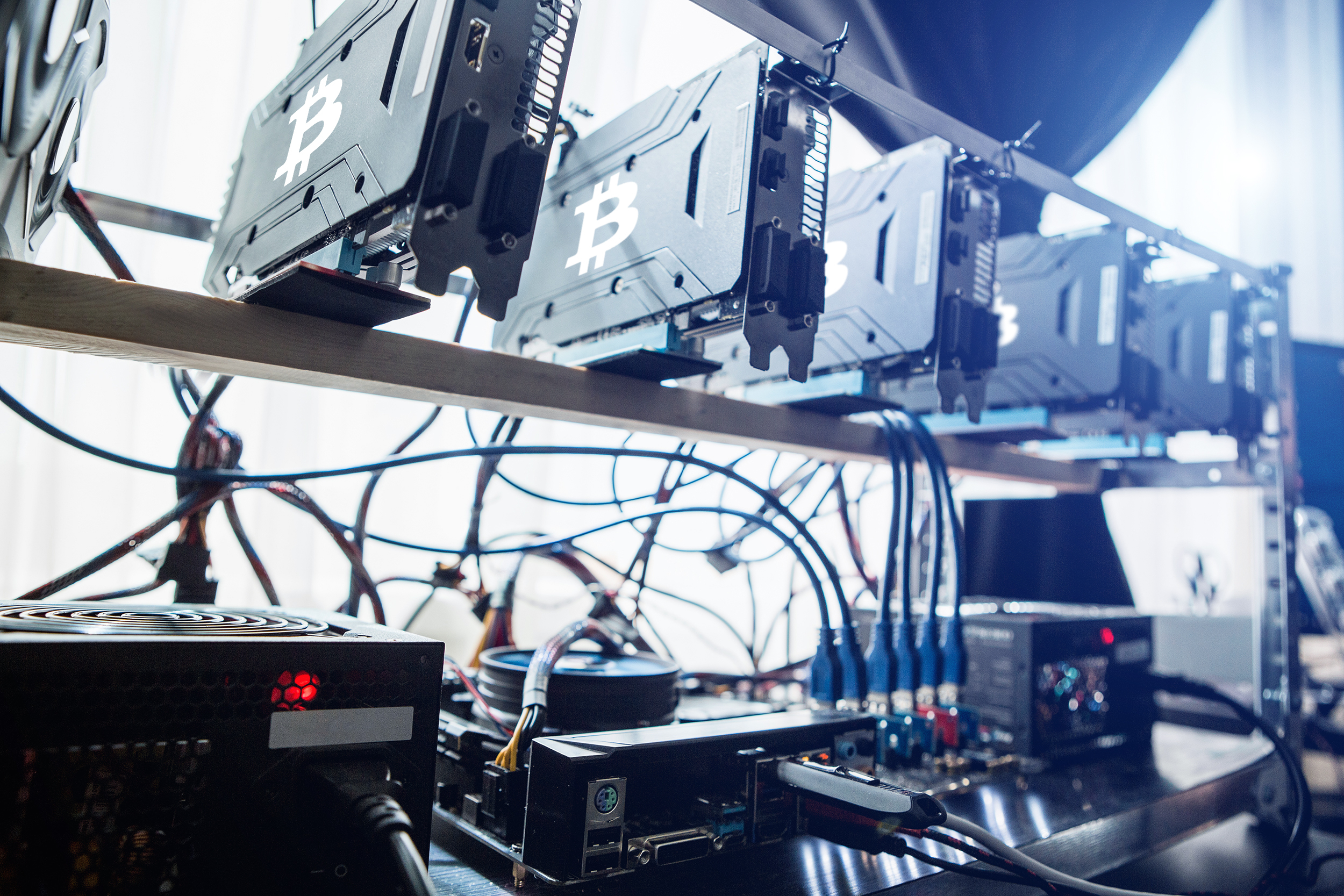
PHOTO COURTESY OF Scharfsinn86
Mining Hardware in 2022
Today, mining equipment takes the form of application specific integrated circuit miners or ASICs for short. These machines have specially designed microprocessors achieving one goal - mine crypto. But they are quite difficult to produce and are expensive to buy. The most popular ASIC miner belongs to the series of Bitmain Antminer systems. They have several units ranging from the affordable options hovering under $2,000 with 1200GH/s mining capacity, to units well over $10,000 with 104TH/s mining capacity (check our previous blog about hashrates). They are even coming out with a unit that will perform at 198TH/s, scheduled to release in May 2022.
As we continue to march forward into 2022, there is an interesting trend developing in the GPU market. Average GPU prices actually dropped 11% over the month of February. This is good news for the mining market, but you shouldn’t get too comfortable. It is highly unlikely that this trend continues for much longer given global inflation, supply chain issues, an actual war and not to mention the overall volatility that is the crypto market. It is something to look at, but too early to tell if this will be the 2022 trend.
However, plenty of profitability exists at the ground level. Miners are willing to front the initial costs of this equipment, almost as an investment, in the hopes of amassing Bitcoin in return. The industry is privy to this which is why having the most powerful miners on the market will be an attractive selling point. There are even tools out there that can list miners on the market and estimate profits for you.
Is Bitcoin Still The Best Thing to Mine?
Short answer? Yes. Bitcoin, on average, is worth ten times more than its closest competitor, so the returns are hard to argue. If your barrier to entry is high enough for the really good machines, then you can expect good profit. Most of the altcoins on the market can do this as well, but you must remember that a solid chunk of that market doesn’t hold or continually increase its value compared to Bitcoin. They can give short term profits but don’t expect sustainability in the long run. Bitcoin will soar to unimaginable heights in the coming years, so aiming to mine for it now is quite logical. In fact, in the month of April 2021 alone, around $3 billion in Bitcoin was mined.
However, this subject is a bit nuanced. With climate change worsening in our world, products with high energy consumption are being put under the magnifying glass with heavy scrutiny. It is no secret or surprise that crypto mining can be a high energy draw - miners get hot. On top of the energy miners need to run, you must figure out a way to cool them, which generally requires a decent amount of work and can get pricey, a few extra fans won’t cut it here. When you scale up to a warehouse full of miners, that’s another level of energy consumption and costs to consider. World governments want to reduce their carbon footprint, and rightfully so. What will have to happen is for technology to improve for more efficient miners and cooling methods.
Where to Next?
The bulk of mining has historically belonged to the individual; there is power in numbers. It was only recently that entities started entering the space, which of course swells demand and price. It also doesn’t help when you factor in the difficulties the microprocessor industry has had in the past couple of years.
Either way, this trend will continue to evolve and ASIC miner markets will saturate even further. There will be more capital invested in mining equipment, pools and companies. This can provide opportunities for everyone from the hobbyist miner, to companies looking to expand their mining operations, to enterprise class mining services (Blockstream Mining for example). However, the bar of entry into this industry will climb as it becomes more lucrative and the technology gets better, but this will make a profitable average home-setup harder to achieve. With companies like Intel, Nvidia and AMD promising high performing graphics cards this year, there are hopeful sights regarding the forward movement of this technology.
In the next post, we will discuss the macro mining industry - the facilities around the world dedicated to mining. Thanks for reading!
Diamaan gueye
Discover related insights
Bitcoin Mining; A Series - Part 1: The Ups, Downs and Rebounds
A quick introduction into Bitcoin mining, its 2021 and its future.
BITCOIN MINING; A SERIES - PART 2: HASHRATE