BITCOIN MINING; A SERIES - PART 2: HASHRATE
%20--%3e%3csvg%20version='1.1'%20id='Layer_1'%20xmlns='http://www.w3.org/2000/svg'%20xmlns:xlink='http://www.w3.org/1999/xlink'%20x='0px'%20y='0px'%20viewBox='0%200%20295.5%20295.5'%20style='enable-background:new%200%200%20295.5%20295.5;'%20xml:space='preserve'%3e%3cstyle%20type='text/css'%3e%20.st0{fill:%23231F20;}%20%3c/style%3e%3ctitle%3eclock%20icon%3c/title%3e%3cpath%20class='st0'%20d='M268.8,147.7c0,66.9-54.2,121.1-121.1,121.1c-66.9,0-121.1-54.2-121.1-121.1S80.9,26.6,147.8,26.6V0%20C66.1,0,0,66.1,0,147.8s66.1,147.8,147.8,147.8s147.8-66.1,147.8-147.8c0,0,0,0,0,0H268.8z'/%3e%3cpolygon%20class='st0'%20points='134.4,80.6%20134.4,134.4%20134.4,147.8%20134.4,161.1%20187.8,161.1%20187.8,134.4%20161.1,134.4%20161.1,80.6%20'/%3e%3c/svg%3e) 6 min read
6 min readWhat measures the world’s Bitcoin mining performance? It’s something called hashrate. You may have started hearing this term more in recent months or years, and this is for good reason in the mining world. In this entry of our Bitcoin mining series, we will get into some details of the significance of the Bitcoin hashrate, it’s behavior over the past year and what the future may hold.
PHOTO COURTESY OF Michal Bednarek
Hashrate Defined
Firstly, what is hashrate? Simply put, it measures the Bitcoin network’s computing power when verifying transactions and adding blocks to on the blockchain per second. It is essentially the collective of hardware connected to and participating in the mining process of Bitcoin. So the more computers mining, the higher the hashrate. Think of it like an internal combustion engine. The more air and fuel sucked into the engine, the more power it makes. Anything that throttles this input reduces the power output.
Specifically, it is measured in hash calculations (transaction verification) per second. The common unit measurements range from thousands (kH), millions (MH), billions (GH - Giga), trillions (TH - tera) or quintillions (EH - Exa), the latter of which is used for the entire network hashrate.
In order to make ¢0.01 of BTC today, and factoring in electricity costs, you’d need a machine with a hashrate capable of about 50GH/s, or 50 billion hashes per second. The most expensive machines have hashrates in the trillions, but are the-cost-of-a new-car expensive. However, they can yield hundreds of dollars a day in profit if set up properly. The upcoming Goldshell KD6 can mine at a whopping 26.3TH/s, but expect to pony up with a price tag of over $50,000. Machines more within the realm of purchasability for most, let’s say under $2,000, hover around the 500MH/s mark. We will dive more into detail on the uptrending mining GPU industry in the next article entry.
It’s Significance
There are two main reasons why a network with a high hashrate is important. Transaction validation security depends on the number of computers in the mining pool. The more there are, the more secure the network becomes. Also, the entire point of mining is the Bitcoin reward, which provides incentive, thus completing the continuous cycle of securely adding blocks to the chain.
When the Bitcoin price rises, the rewarded Bitcoin is more valuable, bringing more machines online. But when the price drops, mining efficiency lowers and the hashrate goes down as some miners take themselves offline when profit no longer exists at a predetermined price. However, the jury is still out on whether price determines hashrate or if hashrate determines price. What do you think?
https://www.coinwarz.com/mining/bitcoin/hashrate-chart
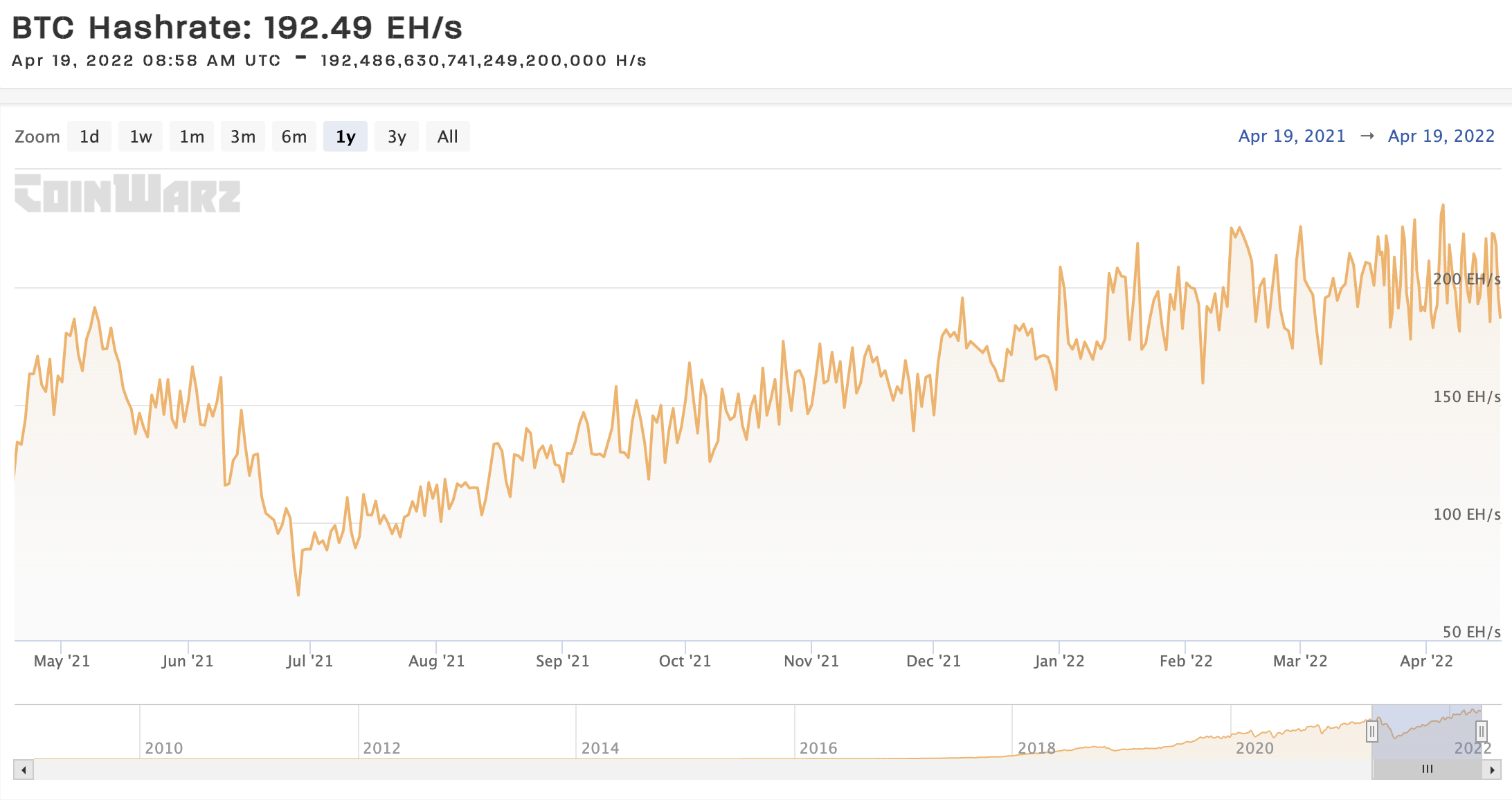
Last year saw the most volatile year for hashrates to date with historic highs and lows. Early May we saw a then record hashrate of 191 EH/s, with little signs slowing. However, within weeks, it hit a two year low of just 69 EH/s. This was primarily due China (at the time, the largest crypto mining country) banning mining in July 2021 and the rumors leading up to that point, causing nearly a 50% drop in the network hashrate. The hashrate built itself back to where it was last summer, and in fact hit another all time high with 218 EH/s in late January 2022, and is now comfortably hovering around 200 EH/s. But as you can see, the performance is very dependent on the machines doing the work.
What Are We In For?
A high hashrate is a double edged sword. It’s great for the network, providing increased security and stability, but reduces profitability thanks to the increased competition. One can say it puts the control of the network hashrate in the hands of those with the hardware to overcome these difficulties, e.g. mining-dedicated entities.
Part of the quick rebound was actually due to the Chinese ban on mining; it opened doors for others to fill that void. For example, the US and Canada saw an injection of venture funding aimed at mining projects. Kazakhstan is also a big mining player now, accounting for over 18% of the network hashrate. As this industry galvanises, hashrate will only rise and hit never-seen-before levels, and this is likely what we’ll see throughout 2022.
Crypto mining is not something you find humming away in your friends basement anymore, companies are being built around it. Soon, in the same way you saw data centers become the norm, crypto mining centers will be as well.
Stay tuned for the next entry, as we get into the world of mining machines!
DIAMAAN GUEYE
Discover related insights

Bitcoin Mining; A Series - Part 1: The Ups, Downs and Rebounds
A quick introduction into Bitcoin mining, its 2021 and its future.
BITCOIN MINING; A SERIES - PART 2: HASHRATE