DIRECT LISTING TOKENIZED STOCKS - A NEW CHALLENGE TO THE IPO
%20--%3e%3csvg%20version='1.1'%20id='Layer_1'%20xmlns='http://www.w3.org/2000/svg'%20xmlns:xlink='http://www.w3.org/1999/xlink'%20x='0px'%20y='0px'%20viewBox='0%200%20295.5%20295.5'%20style='enable-background:new%200%200%20295.5%20295.5;'%20xml:space='preserve'%3e%3cstyle%20type='text/css'%3e%20.st0{fill:%23231F20;}%20%3c/style%3e%3ctitle%3eclock%20icon%3c/title%3e%3cpath%20class='st0'%20d='M268.8,147.7c0,66.9-54.2,121.1-121.1,121.1c-66.9,0-121.1-54.2-121.1-121.1S80.9,26.6,147.8,26.6V0%20C66.1,0,0,66.1,0,147.8s66.1,147.8,147.8,147.8s147.8-66.1,147.8-147.8c0,0,0,0,0,0H268.8z'/%3e%3cpolygon%20class='st0'%20points='134.4,80.6%20134.4,134.4%20134.4,147.8%20134.4,161.1%20187.8,161.1%20187.8,134.4%20161.1,134.4%20161.1,80.6%20'/%3e%3c/svg%3e) 4 min read
4 min readA recent development in the world of capital markets is the growing interest in direct listing among tech unicorns. Not long ago, Barry McCarthy, Spotify CFO, mentioned that the traditional IPO process is moronic and hasn't evolved in decades.
The world of digitised finance has opened so many doors to how businesses fundraise, rising over what is considered the “norm”. We are at the edge of a massive capital market evolution. Direct listing of tokenized stocks will not only enable access to a larger geographic audience, but will reduce the listing and compliance costs with a higher level of investor protection and transparency.
Direct listing - what is it?
The concept of direct listing is quite simple; once a company is ready to publicly trade their shares, they list them directly onto an exchange of the company’s choice - plain and simple. It omits the outside help of banks, VC’s or hedge funds. Companies are responsible for setting their own reference price, determining share counts, finding the right exchange and promoting their listing. The only conceivable drawback is that a successful direct listing will be associated with how well a company can handle this. An investor base - people who already know about the company - already established is also important. But that can change as more companies buy into the idea.
Advantages of direct listing
Now, there are clearly many benefits here. Usually, companies use investment banks and other intermediaries for things like underwriting stock issuance and putting their shares on an exchange - “taking them public” as is said. But the idea here is for the companies to do it all themselves, which could save cost and time. It completely forgoes the entire spiel of creating price ranges, underwriting, pitching investment banks or selling off large chunks to investors before going live, all costly things to do.
This is also good for investors, as it widens the scope of who can get shares once they are made public. Traditionally, the IPO process favors giving the investor circles that worked with the company’s investment banks first looks at owning shares. With direct listing, it’s on a more first-come-first-serve basis, potentially strengthening the impact the listing could make as it is more accessible to everyone.
Just think a moment, crypto exchanges such as Bitfinex, Binance, Coinbase or Kraken are rising in popularity as crypto currency rises in value. If they provide an opportunity to list digital shares in a tokenized form, the impact can be huge.
Companies currently in on it
While NASDAQ has been listing stocks directly since the mid 2000’s, the idea has recently gained notoriety through Spotify’s direct listing in 2018. Slack did the same in early 2019 and even as recent as last month, Asana and Palantir have both directly listed shares. However, the most anticipated listing for 2020 is Airbnb, rumored to be going the direct listing route according to TechCrunch.
Right now, it seems that only companies with an already large following and investor base are eager to take the direct listing route. If a company is looking to raise capital, a direct listing may not be the best option, as it hasn’t yet proven it can best how IPOs accomplish this. However, this could change as we see more direct listings.
How STOKR and tokenization fits in
Security tokens have already proven their worthiness as secure and near instant tradable financial assets. A big advantage security tokens have is the reduced compliance costs thanks to automation. There is little wiggle room around high manual compliance costs for listing on stock exchanges which are crucial to getting an IPO off the ground, and this is what makes the lower cost method of direct listing an interesting alternative. Tokenized stocks can be listed directly on regulated digital assets exchanges without requiring intermediaries. Thanks to high-level automated processes, direct listing with security tokens will change the game.
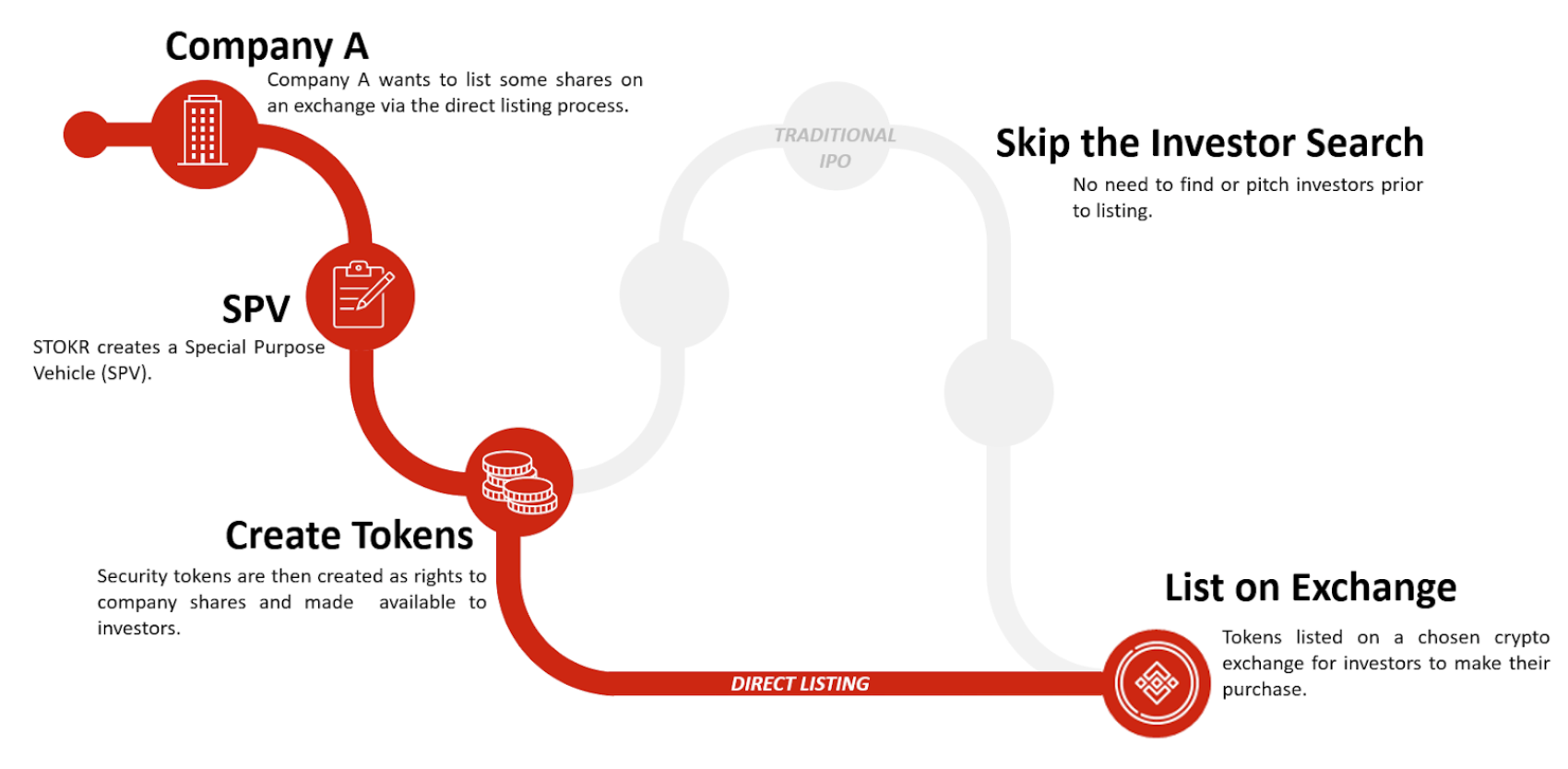
Benefits of direct listing of tokenized stocks
Tokenization will magnify the previously listed benefits of direct listing. Direct listing of tokenized stocks will enable European companies to provide their investors and employees with access to their liquidity. As there is no lock-up period for such direct listing, investors can trade the tokenized stocks from day one. As tokenized stocks will be regulated as a financial instrument, investors can enjoy the statutory investor rights like financial information or insider trading restrictions.
To wrap up
Direct listing was chosen as a free market approach by Spotify. We believe tokenized direct listings will make direct listing more accessible and desirable not only for industry unicorns, but also for the zebras. Remember the striped animals, they aren’t imaginary!
STOKR is already well ahead of the curve. We have the ability to properly and legally create the desired tokenized stocks of your company that you may directly list on a regulated digital asset exchange.
Key takeaways
- The direct listing process eliminates the need for underwriting, intermediaries and other timely and costly required methods for a company to successfully raise capital. It makes it easier for any investor to “get in on the ground level”.
- Ventures must have a sound ability to market themselves, choose the type of direct listing they want to enlist and generally handle everything that would go into an IPO themselves.
- Companies such as Spotify, Asana, and Palantir have already done a direct listing. Airbnb is planning on one sometime before the end of 2020.
- Direct listing of tokenized stocks into a regulated digital assets exchange will be the future. Tokenized direct listing are simpler and more cost effective.
Are you interested in using an STO platform like STOKR? Head to our home page to learn more or reach out to us directly at [email protected].
BY DIAMAAN GUEYE
Discover related insights

STO VS ICO: ALL YOU NEED TO KNOW
The future of investing has its sights resting on security tokens. Initial public offerings are trending in the direction of using digital currency to represent investments. STOs have risen as the need for regulation of blockchain investment that ICOs tend to lack. Due to its safety and security, it’s the method most investors and regulators will want to use in the future.
Blockstream bringt Bitcoin Mining-Security Token auf STOKR heraus


