STO VS ICO: ALL YOU NEED TO KNOW
%20--%3e%3csvg%20version='1.1'%20id='Layer_1'%20xmlns='http://www.w3.org/2000/svg'%20xmlns:xlink='http://www.w3.org/1999/xlink'%20x='0px'%20y='0px'%20viewBox='0%200%20295.5%20295.5'%20style='enable-background:new%200%200%20295.5%20295.5;'%20xml:space='preserve'%3e%3cstyle%20type='text/css'%3e%20.st0{fill:%23231F20;}%20%3c/style%3e%3ctitle%3eclock%20icon%3c/title%3e%3cpath%20class='st0'%20d='M268.8,147.7c0,66.9-54.2,121.1-121.1,121.1c-66.9,0-121.1-54.2-121.1-121.1S80.9,26.6,147.8,26.6V0%20C66.1,0,0,66.1,0,147.8s66.1,147.8,147.8,147.8s147.8-66.1,147.8-147.8c0,0,0,0,0,0H268.8z'/%3e%3cpolygon%20class='st0'%20points='134.4,80.6%20134.4,134.4%20134.4,147.8%20134.4,161.1%20187.8,161.1%20187.8,134.4%20161.1,134.4%20161.1,80.6%20'/%3e%3c/svg%3e) 6 min read
6 min readSTO VS ICO - INTRODUCTION
If you were an investor in the earlier cryptocurrency or blockchain space, it’s likely that you came across what is called an ‘ICO’ or an ‘Initial Coin Offering’. ICOs opened the door for token-based investments for blockchain companies as a way to raise investor money without going into complex prospectus filing. However, there’s a new strategy on the block aiming to address the shortcomings of ICOs and make token-based investments legally safe and secure for founders and investors - it’s called an STO. We’ll take a deep dive into the entire STO (security token offering) vs ICO discussion that is common in most investment circles today.
The different types of tokens
The blockchain boom was a very important time period when it comes to investing. The idea of a decentralized, anonymous, and secure currency was becoming more and more popular as the early 2010s rolled on, particularly in the investment crowd. To get to the root of what is the STO vs ICO debate, you must understand what “tokens” are, what they do and what exactly is a token-based investment.
Tokens are the cryptocurrency-based assets that investors get when they decide to invest in a company or project. When it comes to STO vs ICO dividends, each can be received in different ways. Depending on the investment, the investor is entitled to tokens which grant them certain access, services, or ownership of whatever they are investing in. There are three types of tokens: payment, utility, and security.
- Payment tokens are similar to regular fiat currencies as they are used for payment purposes. Usually they are pegged to a certain price. They just aren’t officially backed by any government or financial institution.
- Utility tokens reward investors with company access rights in a digital environment. For example, you need Ether to interact with any smart contracts on Ethereum. Some have even compared them with in-game currencies. These kind of tokens are largely unregulated globally.
- Security tokens qualify as ‘transferable securities’ (specific to EU classification of securities). They represent financial instruments like equity, debt, or profit sharing rights in the form of a cryptographic token.
ICO vs STO
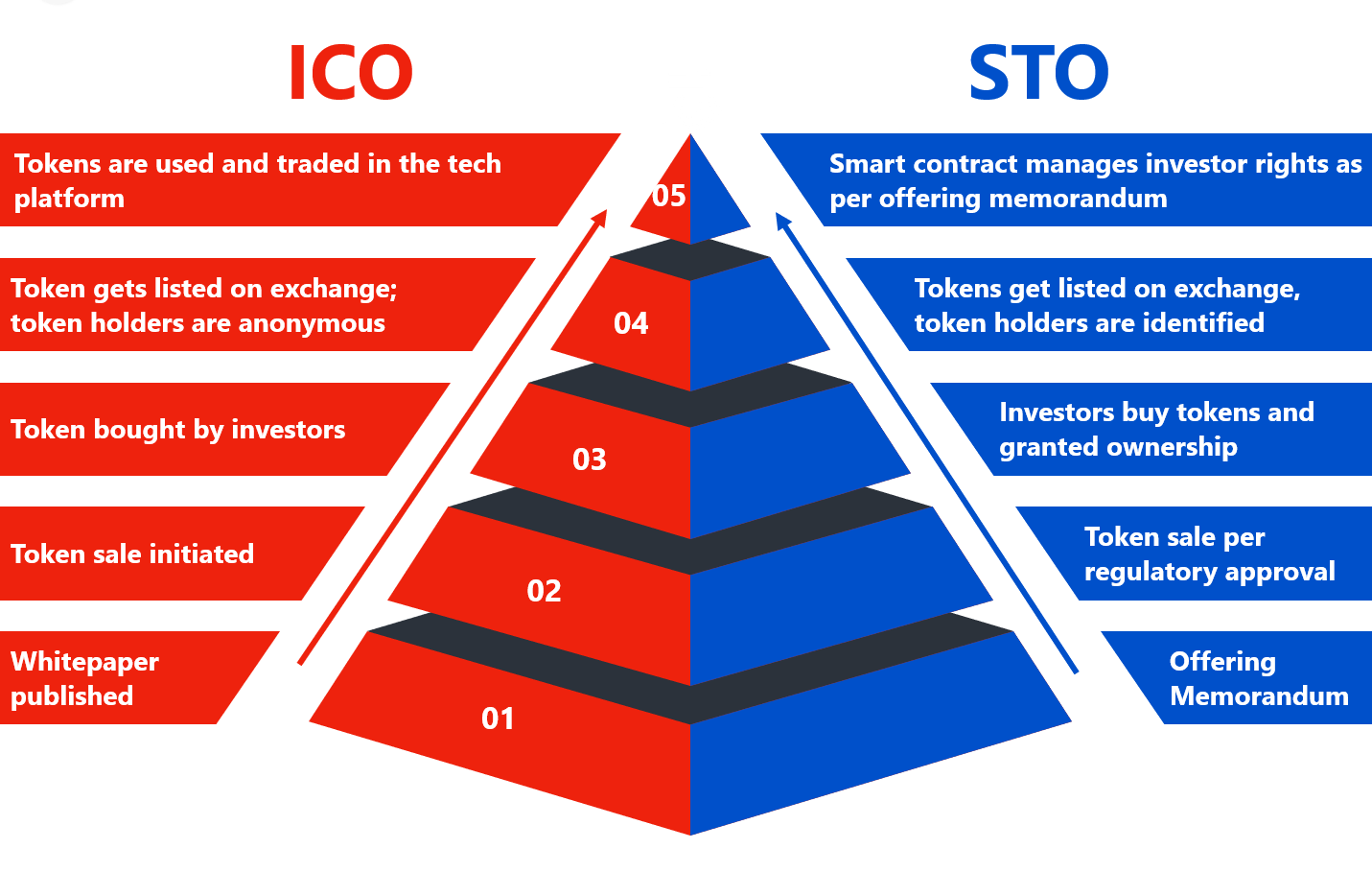
Token offerings are the product of the crowdfunding boom that took over the finance world in the early 2010s. ICOs surfaced as blockchain technology became popular. It enabled everyone to be active investors, helping companies or projects raise funding without the need for elusive VC or angel funding. ICOs are meant for raising funds in an unregulated market. They gained popularity due to their ease of launching. By using utility tokens as a reward, many projects tried to bypass regulatory scrutiny from the SEC or FINMA - less paperwork and laboring over compliance procedures yields a quicker path to getting a project off the ground. Many projects and companies offering tech services/goods have used ICOs to launch.
However, faster isn’t always better. STOs contrast with one major difference - the issued tokens are regulated unlike in an ICO. STOs are gaining traction because of this. Regulators are only going to impose more watchful eyes on the crypto space as the technology moves forward. Given this, STOs could eventually make ICOs obsolete as they are forced to abide by government regulations.
Advantages & Disadvantages of STO and ICO

ICOs have been the easiest route to funding. The entry barrier for buyers and sellers is essentially non-existent with no regulations for how one is launched, how funds are managed or how tokens are distributed. You can launch one right now if you want - if you can get the tech ready and successfully promote your campaign to get investors on board, you can start funding your project almost immediately. Another big advantage is that anyone can contribute to investing since it is a crowdfund. This goes around the need to find a VC which is a complicated process.
ICOs do have their faults, and as blockchain becomes more mainstream, they will only become more problematic. The most glaring issue is what makes it so simplistic - it’s unregulated. Investors are not protected from any fraudulent crowd sales or projects that don’t deliver as promised. It’s also highly volatile. Even if an ICO does well and is listed on a crypto exchange, it’s still subject to the up-and-down nature of cryptocurrency, which all gives it a high level of risk.
STOs, however, offer a higher level of security, giving investors much needed peace-of-mind knowing that companies are bound by investor protection laws. The aim with STOs is not only to regulate the wild west of blockchain crowdfunding, but also provide access to existing capital markets.. Companies that launch STOs must embrace transparency with a clearly defined and scalable business model to make them more mature and reliable. Security tokens also represent tangible assets, more than mere access rights, such as stocks, bonds, funds, investment trusts; all on a secure blockchain network. Moreover, security tokens can be well accessed both by accredited and retail investors - opening the online investment world for everybody.
What’s best for me?
The whole “why STO vs ICO” debate is not that complex. They aim to achieve the same goal, but go about it in very different ways. Given the negatives of an ICO, it’s tough to argue how quickly funding can pour in. However, for investors, it’s a risky endeavor as they are not protected under any form of regulation. STOs are aimed at protecting the investors at the expense of slower and more time consuming launch processes for companies. It really depends on what you’re doing in the investment space and what your goals are.
The STOKR platform specializes in supporting companies to launch regulated STOs. STOKR requires all investors to be KYC/AML compliant to ensure total security when peer-to-peer trading occurs using our service. We have a full write up on STOs and how to launch one in Europe, so check it out if you are keen to learn more.
Wrap Up
The future of investing has its sights resting on security tokens. Initial public offerings are trending in the direction of using digital currency to represent investments. STOs have risen as the need for regulation of blockchain investment that ICOs tend to lack. Due to its safety and security, it’s the method most investors and regulators will want to use in the future.
Takeaways
- The STO vs IPO vs ICO discussion has begun to take shape as we are seeing which option is the most congruent with modern times.
- You can either have it done fast or done right. ICOs are focused on making funding easy for companies, while STOs are focused on protecting investments and keeping everything legal.
- There are more barriers to legally launch an STO, but investors prefer for their investments to be secure, so this is a necessary hurdle.
- Governing financial bodies such as the SEC or FINMA, look favorably on STOs since they follow some sort of regulation. It is trending to becoming the standard.
- STOKR provides the highest level of security for investors on a launch platform while making it easy for companies to set up an STO.
Did reading about STOs vs ICOs leave you hungry to learn more? To invest in innovative companies or to raise investments through the STOKR marketplace, follow this link.
BY DIAMAAN GUEYE
Discover related insights

2020 YEAR IN REVIEW
Although 2020 provided us with many new challenges like never before, we were able to transform them into opportunities. There were a lot of highs and a lot of lows. Our adaptability and flexibility had reached new heights.

INVESTING IN SHARES: A BEGINNER’S GUIDE


