• Invest
  • Solutions
  • Media
  • Team
Log in
  • Invest
  • solutions
  • End-to-End Tokenization
  • Tokenization-as-a-Service
  • media
  • Press Releases
  • Stoke Post
  • Team
FOLLOW US
Linkedin LogoX LogoTelegram LogoYoutube Logo
MORE POSTS
Share
NEWSLETTER

STOKR INSIGHTS – ISSUE 001

reading time4 min read
03 Apr 2026


STOKR Insights — Issue 001 — April 03, 2026
STOKR Insights Issue 001. U.S. regulators publish first structured crypto taxonomy. Wall Street responds with production-grade infrastructure. Where the convergence creates opportunity.͏ ‌ ͏ ‌ ͏ ‌ ͏ ‌ 
STOKR Insights
New rails. New signals.
Capital markets in transition.
Tokenisation, Bitcoin infrastructure, and capital markets — bi-weekly intelligence from STOKR
Welcome

Introducing STOKR Insights

Founded in 2018, STOKR operates at the intersection of tokenisation, Bitcoin infrastructure, and capital markets. With over $1.8 billion in tokenised assets issued and a core focus on private credit, energy, and Bitcoin mining infrastructure, our platform is developed around bringing institutional-grade financial products on-chain. Our newly launched newsletter STOKR INSIGHTS reflects that positioning.

WHAT STOKR INSIGHTS COVERS

• Structural shifts across Bitcoin, mining, energy, and tokenised capital markets

• Regulatory landscape shaping institutional participation with tokenisation

• Where market infrastructure is being built

 
KEY FIGURES

BTC Price

$66,813

as of Apr 02

Hashprice

$32.84

USD / PH / day

Difficulty

133.79T

next adj. ~Apr 03

Basel Capital Charge

100%

1,250% risk weight

INSIGHTS 001 AT A GLANCE
U.S. regulators introduced the first structured taxonomy for crypto-assets. Within days, Wall Street moved to build against it. At the same time, the Basel backdrop that has constrained bank participation is beginning to shift. This issue looks at how these layers connect and where that interplay creates market changes.
Regulatory

Two frameworks in one week: the infrastructure race

In a single week, U.S. regulators and market infrastructure providers moved in alignment.

On March 17, the SEC and CFTC issued a joint interpretive release that replaces years of ambiguity with a formal taxonomy for crypto-assets. The framework distinguishes five categories:

Digital Securities

Securities; tokenised financial instruments (equity, debt, etc.)

Digital Commodities

Not securities; value from protocol operation (e.g. Bitcoin)

Digital Collectibles

Not securities; NFTs and similar assets tied to media, culture, or IP

Digital Tools

Not securities; functional tokens (access, identity, credentials)

Stablecoins

Not securities (if compliant); payment tokens per GENIUS framework

Bitcoin, Ethereum, and Solana fall outside the securities perimeter. Digitally issued equities remain fully regulated. Staking, mining, and airdrops are confirmed as non-securities transactions under defined conditions.

The U.S. now has a coherent regulatory map, one that separates the underlying asset from the investment contract and delineates jurisdiction between the SEC and CFTC.

Institutional execution is happening. Nasdaq, NYSE via Securitize, CME Group, BMO, Google Cloud, and BlackRock are all building digital securities infrastructure in parallel.

SEC Chairman Paul Atkins "On-chain exchange and payment systems that were unimaginable 10 years ago are becoming a reality today."

For European operators, however, the picture remains fragmented. The U.S. taxonomy has no direct standing under Markets in Crypto-Assets Regulation, leaving firms operating across jurisdictions with a structurally dual compliance burden; one taxonomy-driven (US), the other licensing-based (EU).

 
Deep insight

The convergence: two forces reshaping Bitcoin’s market

Spot ETFs have opened a door. BlackRock's iShares Bitcoin Trust and its peers have accumulated trillions in cumulative trading volume. Real institutional capital, moving fast.

But it's still a fraction of what could move.

The larger pools, fixed income allocators, insurance capital, pension funds, remain on the sidelines. Not because they're uninterested. Because the rules they operate under weren't written for Bitcoin. Investment mandates restrict what they can hold. Basel risk weights make direct bank exposure uneconomic. Custody and reporting infrastructure hasn't caught up.

The demand exists. The plumbing doesn't. Yet.

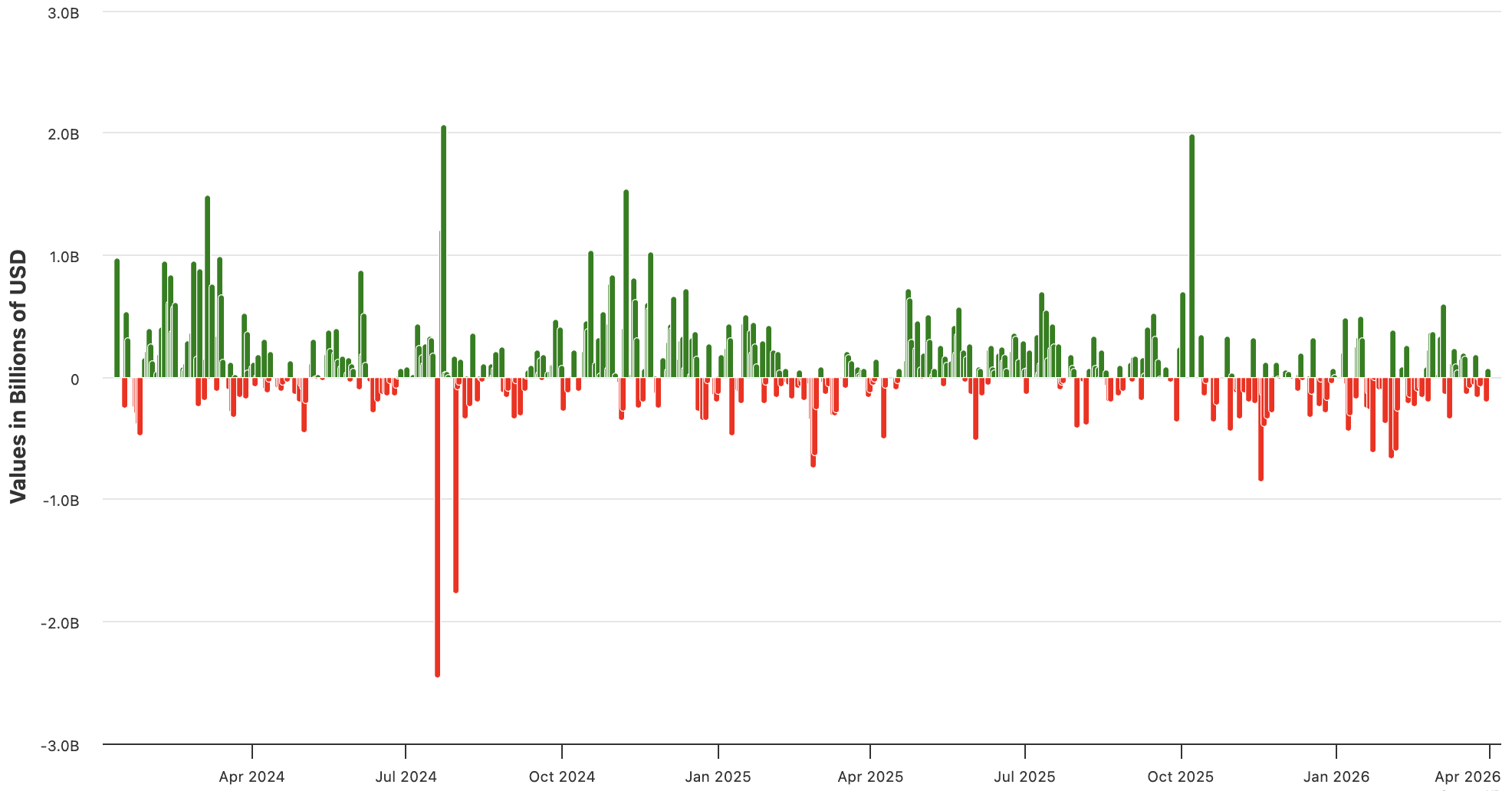
ALL BTC SPOT ETF FLOWS — JAN 2024 TO APR 2026
  Inflows in USD   Outflows in USD
All BTC Spot ETF Flows — Jan 2024 to Apr 2026 bar chart showing daily inflows (green) and outflows (black)

BASEL III ASSIGNS BITCOIN A 1,250% RISK WEIGHT. THAT'S NOT A TYPO.

The math works out to roughly dollar-for-dollar: a $10 million position demands $10 million in capital. For most institutional balance sheets, that makes direct Bitcoin allocation uneconomic before the trade even happens. The 1,250% weight wasn't built for Bitcoin. It was designed as a penalty for opaque, hard-to-value securitization exposures: the kind that blew up in 2008.

Bitcoin is the opposite: liquid, continuously priced, publicly auditable. But the rules don't distinguish. So capital doesn't flow in.

$409M. ONE DAY. ONE TICKER.

Products like Strategy’s STRC convert Bitcoin exposure into fixed income terms, offering yield, par stability, and a structure familiar to institutional balance sheets. The instrument has drawn measurable capital: STRC generated $409 million in a single day's trading volume in March 2026, with average daily volume running at $296 million, making it the most liquid preferred stock in the U.S. market. Institutional allocators including Strive ($50 million), Anchorage Digital, Blackrocks iShares and Prevalon Energy have added it directly to their treasuries. STRC is an early signal of what structured access to Bitcoin can unlock.

WHAT IS STARTING TO CHANGE

STRC is an early proof of concept. But the template it establishes matters: structured Bitcoin products that speak the language of institutional balance sheets can unlock capital that direct exposure never could.

The constraint remains. The workaround is being built in real time. As more instruments emerge across the yield, credit, and equity spectrum, the pool of capital that can engage with Bitcoin without regulatory friction gets larger.

 
STOKR S.A. stokr.io
STOKR is a brand name. The main operations are conducted by STOKR S.A., a public limited company (société anonyme) incorporated in Luxembourg, with its registered office at 9, rue du Laboratoire, L-1911 Luxembourg. The company is registered with the Luxembourg Register of Commerce and Companies under number B226662, holds business license number 10098697/1, and is registered for VAT under number LU31077475. STOKR S.A. is registered as a virtual asset service provider (VASP) with the Luxembourg financial regulator, the Commission de Surveillance du Secteur Financier (CSSF). This communication is for informational purposes only and does not constitute investment advice, an offer, or a solicitation to buy or sell any financial instruments or digital assets.
𝕏
in
Stoke post

Discover related insights

STOKR Appoints Subhankar Sinha as Senior Advisor
PRESS RELEASE

STOKR Appoints Subhankar Sinha as Senior Advisor

STOKR Appoints Subhankar Sinha as Senior Advisor

23 Mar 2026
STOKR UPDATE - FEBRUARY 2026
PRODUCT

STOKR UPDATE - FEBRUARY 2026

06 Feb 2026
An analysis of Luxembourg securities laws in the era of institutional tokenization
TOKENIZATION

An analysis of Luxembourg securities laws in the era of institutional tokenization

06 Feb 2026
    • Solutions
    • 101s
    • Support
    • STOKE POST
    • Team
    • Careers2
    • Memberships
    • Press Releases
    • Legal
    • Privacy Terms
    • Cookie policy
    • Linkedin Logo
    • X Logo
    • Telegram Logo
    • Youtube Logo
STOKR is a virtual asset service provider (VASP),
registered with the Luxembourg regulator CSSF.
Mangopay logo
Copyright 2026 STOKR. All rights reserved.